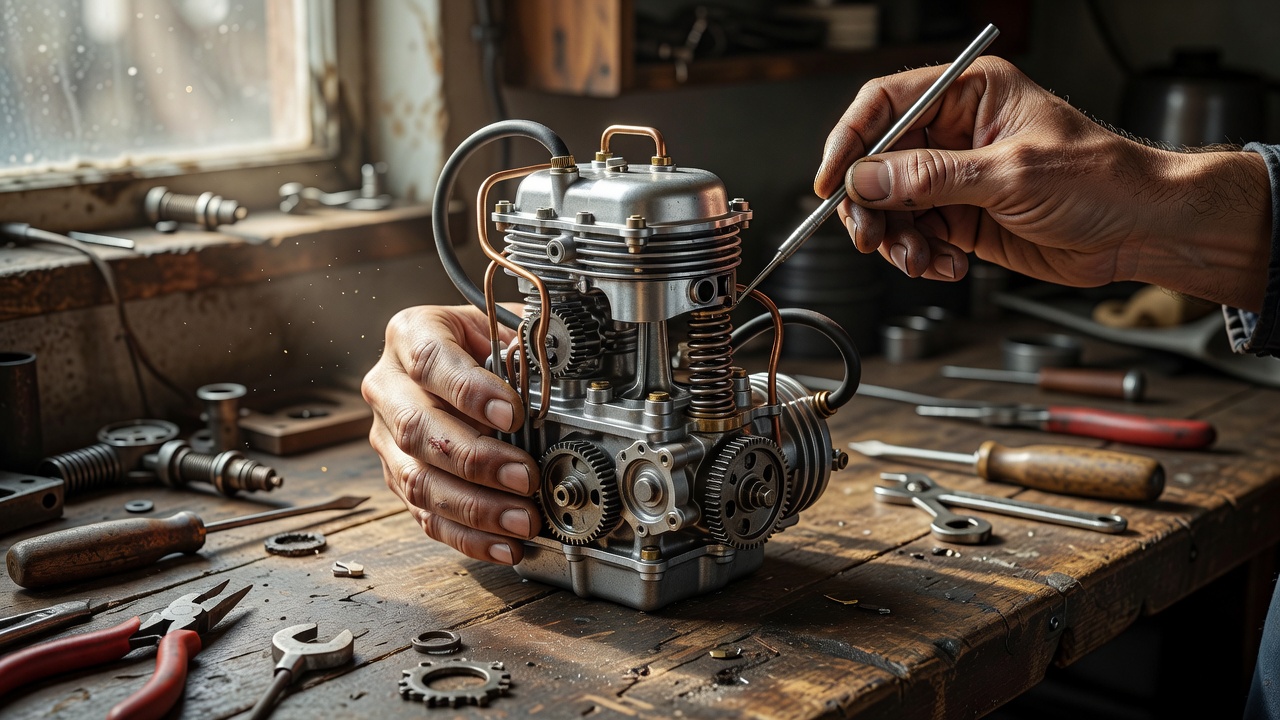
Begin with the energy balance
An engine converts an energy supply into mechanical work. In a heat engine, a working fluid experiences a sequence of changes in pressure, volume and temperature. In a compressed-air model, stored pressure supplies the energy; the model is not generating that energy itself. This distinction matters when two equally lively machines appear side by side on a bench.
Power is the rate of doing work. A flywheel spinning freely can look impressive while delivering little usable output. To compare engines meaningfully, you need torque and rotational speed under a defined load, together with the conditions of the energy supply. A no-load demonstration proves that the engine overcomes its own losses at that operating point. It does not establish efficiency or continuous-duty capability.
Why a smaller cylinder changes the problem
Imagine reducing every linear dimension of a geometrically similar engine to one tenth. Internal volume becomes one thousandth, while surface area becomes one hundredth. The surface-area-to-volume ratio is therefore ten times larger. That geometric result does not predict a complete engine’s efficiency, but it explains why heat exchange with cylinder walls deserves close attention.
Gas leakage also resists simple scaling. A clearance that was acceptable in a larger cylinder may consume too much of a tiny engine’s flow capacity. Tightening the clearance can reduce leakage while increasing sensitivity to alignment, contamination and thermal expansion. A successful miniature is often redesigned around these competing requirements rather than faithfully copied from a full-size drawing.
Four families, four different compromises
A Stirling engine uses a confined working gas and external heating and cooling. Robert Stirling’s name is associated with this engine family. Small demonstration versions can make the cycle visible, but weak temperature differences leave little surplus work. Bearings, seals and displacer alignment can determine whether the engine runs. A displacer generally moves gas between regions; it is not simply another power piston.
A steam engine admits a pressurized working fluid produced elsewhere. James Watt’s historical improvements concern an entire system of energy conversion, not a license to scale a boiler casually. Boiler integrity, water level, relief arrangements and applicable inspection requirements are separate engineering responsibilities. This guide does not provide pressure-vessel construction instructions.
A compressed-air engine can demonstrate valve timing and reciprocating motion without a heated boiler. It still requires pressure-rated components, a suitable regulator and an appropriate air supply. Expansion cooling, moisture and leakage affect behavior. Do not assume that an assembly safe for hand rotation is safe under pressure.
An internal-combustion engine adds mixture preparation, ignition or compression ignition, combustion heat and exhaust handling. Small fuel passages and short operating timescales create their own difficulties. Fuel handling, ventilation, noise and rotating components make this a poor first project for an inexperienced builder. Nicolaus Otto’s four-stroke cycle provides historical context, not a universal description of every model engine.
What the flywheel actually does
A flywheel stores rotational kinetic energy and releases some of it when instantaneous driving torque falls below resisting torque. It can help carry a crank through a dead-center position after the engine is running. It cannot supply net energy indefinitely, repair incorrect timing or compensate for a badly binding bearing. Increasing flywheel inertia also changes starting behavior and the consequences of a mechanical failure.
For observation, separate cyclic speed variation from average speed. A steady-looking wheel may still accelerate and decelerate during each revolution. At low speed, an accessible visual marker can reveal this without requiring a numerical performance claim. Never touch, adjust or apply an improvised brake to a running wheel.
Technical note: thermal expansion and piston fit
Expansion depends on material, temperature change and geometry. A piston and cylinder made from different materials can change clearance as they warm. A room-temperature slip fit is therefore not a complete operating specification. Surface treatment and lubrication must also be considered.
Inspect before introducing energy
Start with the manufacturer’s instructions and the permitted operating conditions. With the energy source isolated, check that the intended motion is unobstructed and that guards and fasteners are appropriate. Hand rotation can reveal a repeatable tight spot, but it cannot certify a pressure system, a flywheel or a fuel installation. Stop if you cannot identify a component’s rating or the correct procedure.
For a first learning exercise, a hand-driven linkage gives clearer feedback with fewer hazards. Record where resistance occurs, whether it changes with direction, and which joint carries the side load. These observations transfer directly to engine diagnosis. The useful habit is not making a tiny engine spin at any cost; it is learning which loss or constraint is preventing controlled motion.
Bench references
- Stirling engine — cycle arrangements and historical context.
- Square–cube law — geometric scaling, not an engine performance model.
- UK Health and Safety Executive: pressure systems — pressure-system hazards and responsibilities; local requirements may differ.
- Flywheel — energy storage and rotational behavior.